Input validation
FASTA, TXT, or CSV; standard 20-amino-acid sequences, 4-50 aa.
Workflow & model
ToxiCompass first screens against curated operational comparators, then conditionally ranks reference-supported target/effect families for rows that pass Stage 1.
Prediction workflow
Stage 2 is positive-only multi-label ranking, not a mutually exclusive 13-class softmax.
FASTA, TXT, or CSV; standard 20-amino-acid sequences, 4-50 aa.
Estimate toxin-like support relative to the benchmark comparators.
Rank 13 retained target/effect-family labels using independent sigmoid scores.
Inspect top-3 candidates, the full vector, row status, and machine-readable exports.
Model architecture
Uses pooled ESM2 embeddings derived from amino-acid sequences for rapid, lower-cost primary ranking.
Adds MSA, physicochemical, predicted-structure, and structure-quality signals for diagnostic analysis.
Lite and Full are complementary. Full is not claimed to uniformly outperform Lite, and predicted structures are not experimental mechanism evidence.
Paper figure 1
The overview connects task formulation and label hierarchy, available data views, the Lite baseline, and the Full multimodal architecture.
Open full-resolution figure
Partial-label semantics
Stage 2 uses target-supervised positive peptides. In the submitted loss, retained positives are contrasted with unretained zero entries; those zeros are unannotated operational comparisons, not verified experimental absences.
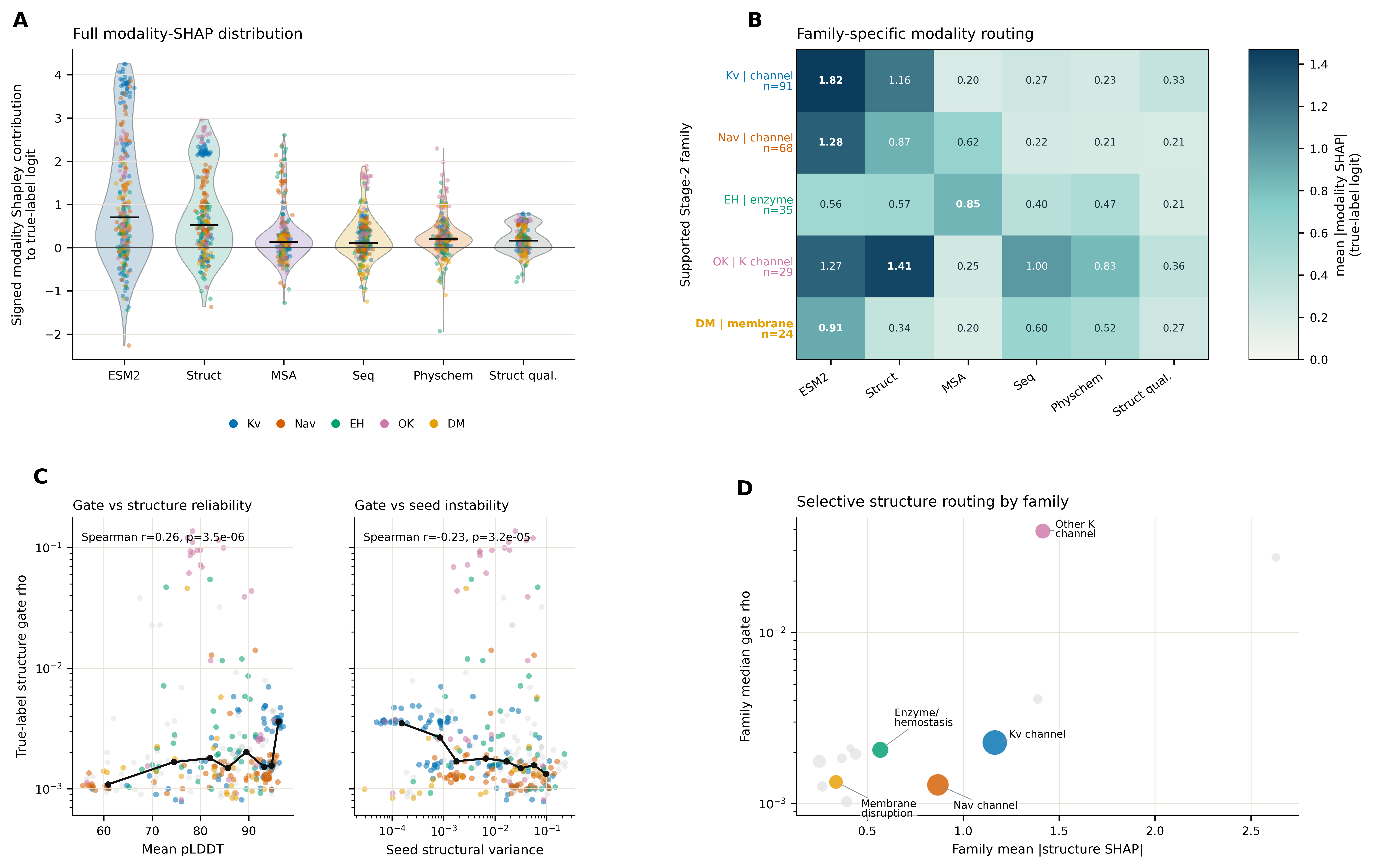
Paper figure 5
The interpretability analysis compares modality contributions and family-specific routing without treating attribution as causal mechanism.
Open full-resolution figure