Dataset
Evidence-curated short-toxin benchmark
The analysis snapshot fixed on 2026-05-22 integrates BioTD and reviewed UniProt records, retains source provenance, and controls train/test similarity at the MMSeqs90 cluster level.
- 6,114
- Stage 1 rows
- 3,057
- curated positives
- 3,057
- operational comparators
- 2,866
- Stage 2 supervised positives
- 13
- retained broad labels
Primary data sources
BioTD and reviewed UniProt records define the benchmark
These are the two principal sources used to construct the frozen BioTD-UniProt short-toxin benchmark. Each record retains source provenance after sequence normalization, evidence review, deduplication, and MMseqs90 cluster-aware splitting.
 Positive evidence source
BioTD
Strict and conservative toxin evidence contributes to the curated positive pool.
Positive evidence source
BioTD
Strict and conservative toxin evidence contributes to the curated positive pool.
biotoxin.net
Open database
 Reviewed protein knowledgebase
UniProt
Reviewed toxin records extend the positive pool; filtered reviewed records supply operational comparators.
Reviewed protein knowledgebase
UniProt
Reviewed toxin records extend the positive pool; filtered reviewed records supply operational comparators.
uniprot.org
Open knowledgebase
Benchmark role: BioTD and UniProt are construction sources. Source membership is not itself a biological label, and the UniProt-derived comparison rows are operational benchmark comparators rather than universally verified non-toxic peptides.
Revision-period robustness evaluation
External cohorts test transfer beyond the benchmark
ConoServer and ArachnoServer provide post-hoc positive cohorts, not benchmark-construction records. After accession, sequence, MMseqs90 cluster, and pairwise-overlap auditing, 59 conopeptides and 28 spider toxins remain non-overlapping with the benchmark. The cohorts were assembled during revision, not as prospective blind validation.
Review robustness evaluation Conopeptide database
ConoServer
Conopeptide database
ConoServer
conoserver.org
59retained
 ArachnoServer
Spider-toxin database
ArachnoServer
ArachnoServer
Spider-toxin database
ArachnoServer
arachnoserver.org
28retained
Positive audit: 114 candidates reviewed, 87 retained, 27 excluded with internal-overlap evidence.
Comparator evidence The 542 operational comparators come from two additional reference services.
 Hemolytik 2.0521 assay-scoped records
 IUPHAR/BPS GtoPdb21 reference records
Construction
Curated sources, explicit evidence
Positive rows combine BioTD strict or conservative evidence with reviewed UniProt toxin records. Exact duplicate sequences are merged while source provenance is retained. Only peptides with retained target/effect supervision enter Stage 2; weak, inferred, or conflicting annotations are not promoted to retained positives. In the submitted loss, unretained zero entries remain operational comparisons rather than verified biological absences.
Comparator candidates are reviewed UniProt peptides filtered to standard 20-amino-acid sequences, 4-50 aa in length, non-overlapping with positives, and length-matched 1:1. These are operational comparators for benchmarking, not experimentally proven non-toxic peptides.
Stage 2 excludes 191 positives without retained target/effect supervision.
Quality control
Cluster-aware before model training
- 01Normalize
Uppercase, standard 20 amino acids, 4-50 aa, exact-unique sequences.
- 02Merge evidence
Retain BioTD and UniProt provenance while masking uncertain labels.
- 03Cluster
Use MMSeqs90 groups as the split unit rather than individual rows.
- 04Audit
Zero exact-sequence overlap, cross-split cluster leakage, or mixed positive/negative clusters.
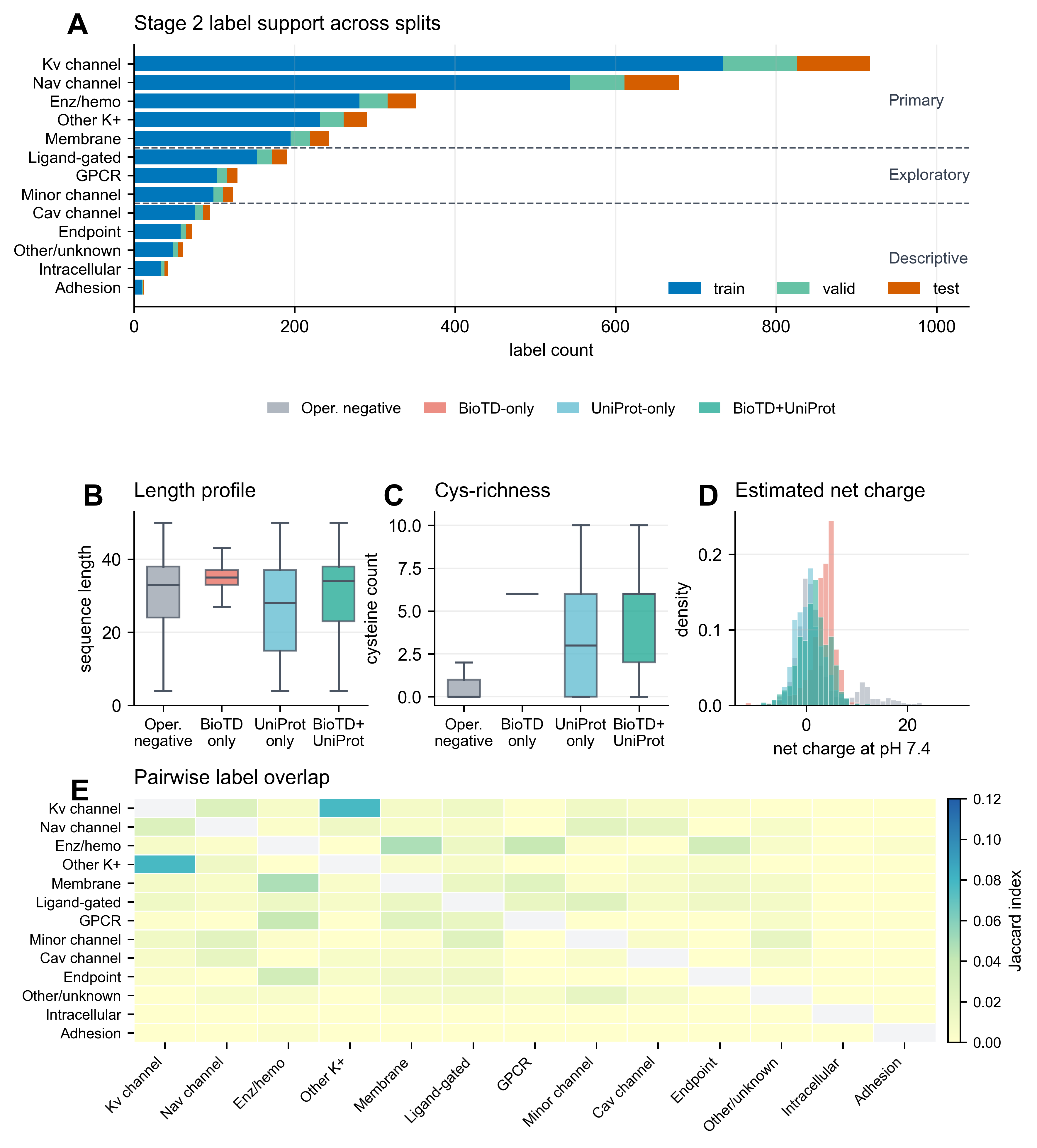
Paper figure 2
Support, composition, and label overlap
The dataset figure reports retained-label support across splits together with sequence length, cysteine richness, estimated net charge, source composition, and pairwise label overlap.
Open full-resolution figure