About MammalTIS
Translation initiation is a key step in the regulation of gene expression. The selection of a translation initiation site determines the starting position of an open reading frame and directly influences the resulting protein product. In addition to canonical annotated start codons, alternative translation initiation can generate upstream open reading frames, N-terminally extended or truncated protein isoforms, and potential novel translation products, thereby increasing the diversity and complexity of the mammalian proteome.
MammalTIS is a public database of translation initiation sites in mammalian transcriptomes, constructed from translation initiation sequencing data, with candidate translation initiation sites identified and annotated using Ribo-TISH. The database currently integrates 76 human TI-seq datasets covering 10 human cell types and 53 mouse TI-seq datasets covering 11 mouse cell or tissue types. In addition, MammalTIS integrates 63 RNA-seq datasets matched to the corresponding cell types for transcript abundance quantification, providing complementary evidence for evaluating the transcripts that may correspond to candidate TISs. All transcript information is based on RefSeq mRNA annotations, using the GRCh38 reference genome for human and the GRCm39 reference genome for mouse.
MammalTIS provides multi-level search and browsing options. Users can search for related genes by cell, search for related transcripts by gene, or directly search for a specific transcript to view its translation initiation site information. At the cell type level, MammalTIS summarizes gene-level non-redundant TIS counts and the proportion of each gene's TISs detected in a selected cell type. At the gene level, MammalTIS provides basic gene information, genomic location, gene-level TIS counts, and cell type-level TIS distributions, including Cell TIS coverage and Cell TIS enrichment. At the transcript level, MammalTIS provides the class of each candidate TIS, codon type, transcript position, genomic position, context score, transcript abundance, number of supporting sequencing samples, and corresponding sequencing sample sources. We expect MammalTIS to serve as an important data resource for translation initiation research and to support candidate TIS screening, functional validation, and the development of related computational models.
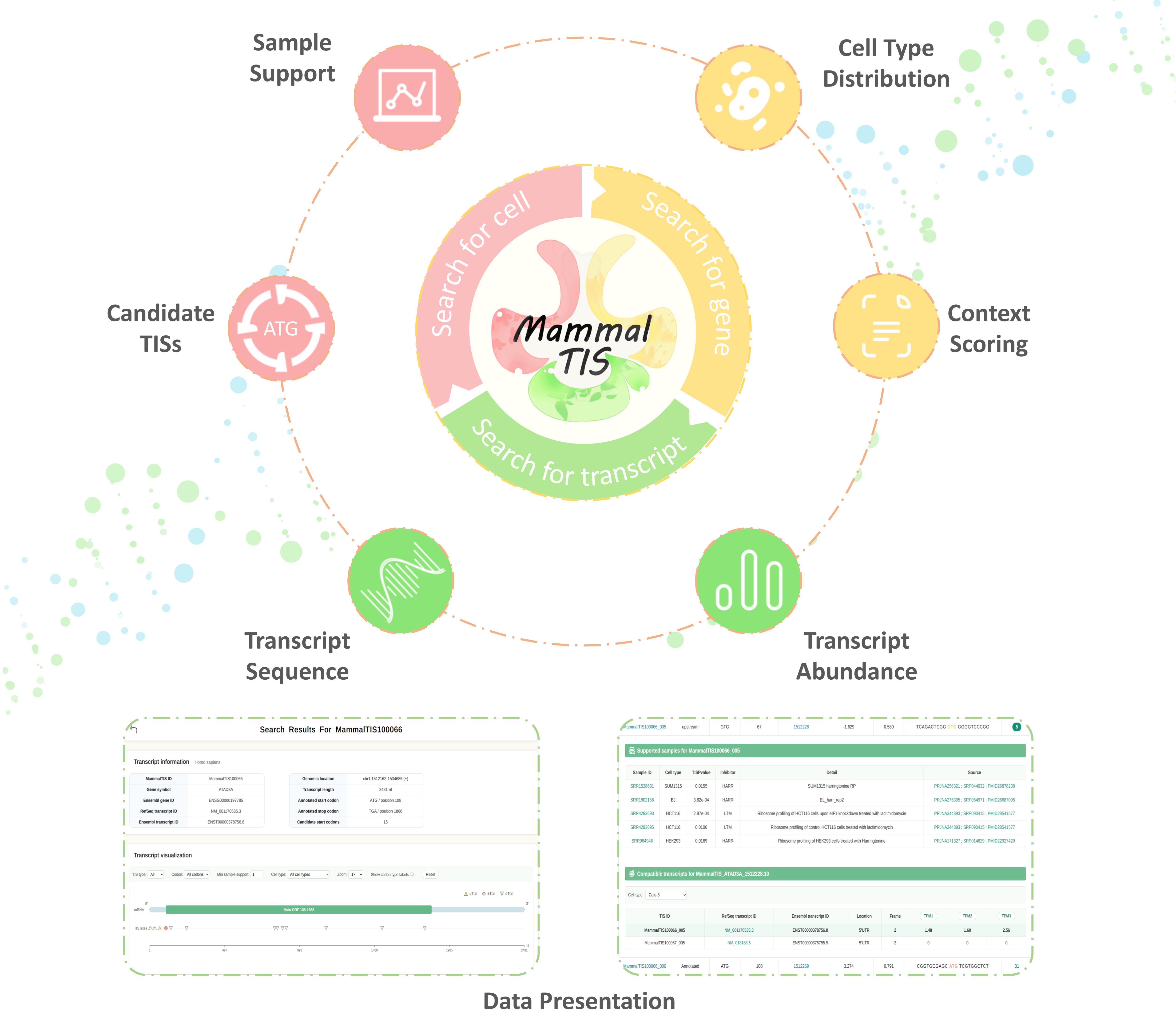
What can MammalTIS do?
- Search TIS information by cell, gene, or transcript.
- Browse genes detected in a selected cell type and their numbers of independent TISs.
- View gene information, genomic location, and related transcripts for a selected gene, and compare the distribution of its TISs across different cell types.
- Browse different types of TISs at the transcript level and view their codon types, positional information, and surrounding sequences.
- Trace the supporting TI-seq samples for each TIS and examine the abundance of compatible transcripts to help assess the potential transcript origin of the TIS.
- Obtain relevant TIS data for studies of alternative translation initiation and computational TIS prediction.